Put two video reels side by side. Same product, same actor, same location. One looks like it cost ten times the other. Most people will say it's the camera. It almost never is. Phones shoot 4K now. The thing your eye is actually reading is the light, and most brands light their stuff like a meeting room.
Flat, even, bright everywhere. Nothing to look at, nothing to feel. Here's what's actually going on.
Cinematic means shadow
The instinct on most shoots is to kill every shadow. Add another light, bump the exposure, make sure the client can see everyone's face clearly. That instinct is exactly what flattens the image. Depth comes from the difference between light and dark. No contrast, no depth. You end up with something that reads as honest and cheap, like a fluorescent-lit pharmacy aisle.
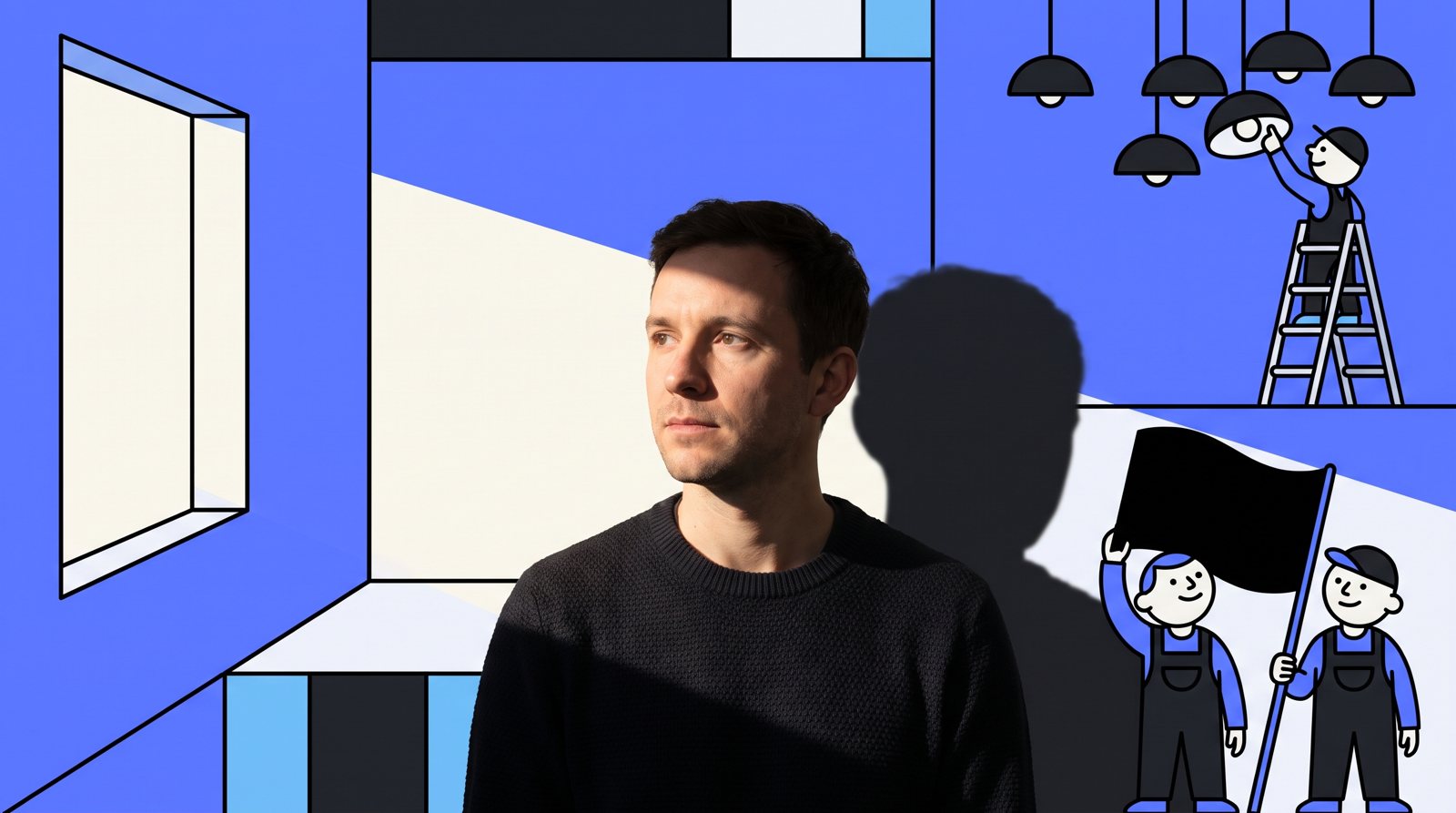
Real cinematic light is directional. One strong source, coming from somewhere specific, that you can point to. A window. A lamp. The sun through a doorway. We call this motivated light, because there's a reason it exists in the frame. The eye trusts it without knowing why. The opposite, light coming from everywhere and nowhere, is what your brain quietly clocks as fake.
So you start with one source and you let the other side of the face fall off into shadow. The trick most people miss is the next part: you don't fill that shadow back in with another light. You shape it with negative fill, a black flag or just a dark surface, to deepen it. You're sculpting with the dark as much as the light.
Soft, hard, and the wall behind them
Soft light wraps; hard light cuts. A big source close to the subject (a window, a bounce) gives gentle gradients, flattering, calm. A small hard source throws sharp shadows and edges, drama, tension, a bit of menace. Neither is "better." Picking the wrong one for the mood is what makes a reel feel off even when nothing's technically broken.
Then there's the background, which brands forget exists. If the wall behind your subject is lit the same as their face, the whole thing goes muddy and the person disappears into it. Let the background go darker, or push a little colour into it: a cold teal slash against a warm face, and suddenly there's separation, layers, somewhere for the eye to sit. Keep your colour temperature honest too. Warm key, cool shadow is most of what people mean when they say a frame looks "filmic."
None of this needs a bigger budget. It needs someone willing to turn lights off instead of on. Stop lighting everything. Light one thing, and let the rest go dark.